Dork Magazine Circa 2006
From 2004-2006 this was home to Dork Magazine
Content is from the site's 2006 archived page, offering just a glimpse of what this site offered its visitors.
Dork strives to inspire its readers by reporting on the people, places and things that embody an impassioned lifestyle. Through its unique coverage of music, design, fashion, culture, cities and artists – Dork presents the muse that encourages others to obsess about the creative process and pursue their own passions. We go beyond “celebrity-ism.” We’re interested in real people, and how they reconcile their reality to make sense of this crazy world. Dork is the voice of the creative and scribe of the passionate.
And I loved reading it when I was in college at New York University. How else to keep up on all the newest cool things that were happening. Coming from a small mid western town I felt really out of it when many of my classmates were from big cities. I was a dork in the true sense since I was an undergraduate in technology, (Computer Engineering) and the sciences. But reading Dork helped me stay on top of the music and art scene. Jump ahead ten years and I actually have made use of my degree. I now work for a company that does custom application development - check them out. Love the job with its different challenges that are presented every day. And after we deliver the finished software tool or package it is not the end of the story. As a custom software developer we do not drop off a CD-ROM or email a file and walk away. Usually, we keep in contract with with the client as they implement and start using their new software. We often step in to make updates and tweaks. The product becomes more useful through the delivery of these enhancements and improvements. I get a real kick out a happy,satisfied client. Age and experience, along with my four years in NYC have given me some sophistication, so I think. I may still be a dork to some folks, but coding and expertise in Salesforce has a certain cachet now-a-days.
DANCING WITH MEDIOCRITY
It’s often said that while searching for the meaning of life and pursuing the almighty dollar, a person can find themselves dancing with mediocrity. That's a lie. No one has ever said that. It sounds like something corny you'd hear in a movie preview. If you think about it, that sentence doesn't even make sense. Simply put, life is not simple and no matter what any of us say, nobody knows what is really going on. I guess Dancing With Mediocrity is everyone's story told from the perspective of a kid in his twenties while living in his parents’ house in Canarsie.
SOCIAL AWARENESS SPOTLIGHT
Tolerance.org is a principal online destination for people interested in dismantling bigotry and creating, in hate's stead, communities that value diversity. If you want to know how to transform yourself, your home, your school, your workplace or your community, Tolerance.org is a place to start, and continue, the journey.
Daily Update : June 30, 2006 | Film. What's New Pussycat?
Film. What's New Pussycat: It seems like Woody Allen is enjoying a bit of a renaissance with the culturati. The success of Match Point and growing anticipation for Scoop have swayed detractors that thought he'd never make another decent film. We'd just like to point out that we never lost hope. Of course we are fanboys.
We'd like to suggest What's New Pussycat?, a classic Allen film, for the long weekend. It is his first screenplay and although the studio butchered his script, you can still see the brilliance that lay on the horizon. It's about a skirt-chasing playboy who wants to be faithful to his wife-to-be but struggles because he has so many women swooning over him. The film is one huge absurdist romp with one of the most insane theme songs ever. Tom Jones rules!
Posted by: james
Film. Winter Passing: So you're a twenty-something struggling actor trying to make it in New York? You also harbor deep-seated resentment towards your dad, right? Okay, I think we've all heard this story before.
But what if your dad were some big deal novelist and you've been promised $100,000 for the publication of love letters written by your dad to your equally revered late mother? What would you do? Don't forget you're broke and living in New York. Photo Credit Stratus Film Company*
Watch the trailer for Winter Passing
Posted by: james
People News. Whitney at 75: Is American culture one of contradiction? With contentious political battles, government branches in discord and party theories like anti-abortion but for the war, the Whitney Collection presents an interesting question through art. It reveals an American story.
As reported today in the NY Times, "The important thing the show does... is deliver the story — a story — of American culture through art. It is a culture of staggering contradictions: idealism and amnesia, censure and unruled pleasure. It is diverse and narrow-souled, with a devotion to the idea of power so ingrained as to make discord inevitable and chronic. If "Full House" is about one thing, it is about discord. It is about how harmonious America never was."
Read more about the Whitney Collection at 75
Posted by: taj
Link Heavy. Adult Swim & Chocolate Industries: Free music is always nice - especially when it's legal. Adult Swim and Chocolate Industries have gotten together and produced Chocolate Swim, an EP which is available for FREE! The album features solid music from Kovas, Lady Sov, Ghislain Poirier, Mos Def & Diverse, and Vast Aire (ft. MF Doom).
In addition, there is an exclusive art book included. The graphic work is really impressive. We're digging the color scheme and cut-out aesthetic. Definitely check out this effort, and support both brands. They've been providing quality outlets for artists like Doom, Dangermouse and others.
Download the Chocolate Swim EP & Art Book
Posted by: taj
Weekend Events. In the Philadelphiatic: Summer events are the best. This weekend there are several jams to attend in the city of brotherly love. First up, check out Boukman Eksperyans, the Solidarity Tour tonight at the World Cafe. Haiti's best known roots music band will be playing their unique blend of Afro-Carribean rock and reggae. Proceeds will benefit the University of Fondwa, Haiti's first and only rural university. It all starts at 7:30 (3025 Walnut St.).
Then, on Saturday our Philly brethren IllVibe are hosting their monthly event, Bodyrock. Deejays Statik, Phillee, Panek, Skipmode and Lil' Dave always present the best in funk and hip-hop. You can catch them at the Aqualounge, located at 323 West Girard Avenue from 10pm til late.
Posted by: taj
Daily Update . June 27, 2006 | Artist. Jay-Z & Reasonable Doubt
Artist. Jay-Z & Reasonable Doubt: It's interesting to think about the aging process. As we get older, are we also aging out of the pool of people who the music industry caters to? We think so - this is evidenced by the ever shrinking amount of new music we're excited about at the record store. So, as a follow-up question, is Hip-Hop a genre that is heavily tethered to an age demographic? Does it need 30 year-olds and older to survive as an art with integrity or can it be passed on to younger generations to keep it going? Who knows - Disco had no inheritance. Some argue that Rock & Roll died with Lennon, Hendrix and Garcia. Obviously there's no right answer, but it's interesting to consider the position of folks who have found their purpose in the music, and now feel an obligation to stay involved - Jay-Z being one of them.
The New York Times has an interesting article on Hova and his Reasonable Doubt Concert. As reported, "If you remember the 90's right now, put one hand in the air right now. That's a cleaned-up version of what Funkmaster Flex said as he warmed up the crowd in Radio City Music Hall on Sunday night. He asked, 'How many people 25 and older?' And thousands of old-timers made some noise. This was a night devoted to ancient history, which explains why Jay-Z rolled onstage in a vintage automobile: a decade-old Lexus." Photo Credit CautionWetPaint
Read more from 10 Years Wiser in the NY Times
Posted by: taj
People News. New Orleans Hit By More Fraud: Unfortunately there's more news about fraud facing New Orleans. Today the NY Times reports on the exploitation of bureaucracy, loop holes and poor management around the tragedy of hurricane Katrina. It's sad to see how much money has missed the purpose of repair.
In today's article, "Among the many superlatives associated with Hurricane Katrina can now be added this one: it produced one of the most extraordinary displays of scams, schemes and stupefying bureaucratic bungles in modern history, costing taxpayers up to $2 billion."
Read more about New Orleans and Fraud
Posted by: taj
Daily Update: June 26, 2006| Audio. Nas Looking Back.
Audio. Nas Looking Back: The other day I was in line at a store and overheard the following conversation between a 14 year old boy and his younger sister: "Sis! Look at what I just got from FYE. It's Nas' first album." The girl replies, "So!" He responds, "So! Are you crazy!? This is one of the best albums of all time." She responds with nonapproval, "How could it be? It only has 10 songs." He immediately puts the cd back in his bag and says, "You don't know anything!"
I love that conversation. It gives us hope that a few younger folks are still reaching into the heyday of hip-hop beyond what the mainstream is feeding them. Was this an outlier? Possibly. We realize that all things change, but it's nice to know that the spectrum of an art-form isn't being forgotten. So from then to now, check out Nas' latest single, Where Y'all At. Although the track is mild in excitement, it still gets the job done. Photo Credit Bakinakwa*
Listen to Nas' latest Where Y'all At!?
Posted by: taj
People. ?uestlove Interviews: We can't wait for Game Theory to debut. We know folks have taken shots at Phrenology, The Tipping Point, et al. but Dork is confident that there's a method to the Roots' madness. Without being too biased, we've always said that their genius won't be appreciated until 20 or 30 years from now, and we still stand behind that statement. But in the meantime, we're definitely enjoying the anticipation of each release.
The Roots' PR team has a strong arm. We've been seeing press and interviews for the upcoming album all over the place. It's really nice to see. Perhaps Def Jam Left will provide the Roots with a platform to further shape the context of their art - to find that niche. Photo Credit StJohn*
Read the following Roots interviews
Posted by: taj
People News. Waiting for the Dough: It's the new age of access and information. What kind of innovations and moments of genius would Einstein have created if he had the tools we have today? Furthermore, what can we do with the tools we have today. I know Dork's often looking for ways to capitalize on these advantages.
The NY Times had a great article about the web and who's taking advantage of this massive tool of outreach and info. As reported this weekend, "NOW and then, an executive whose brain I'm siphoning will turn the tables and pose a question. And lately, I've been getting a few versions of this: 'You talk to a lot of the traditional media companies. Who do you think has got this Internet thing figured out?' That is a tough but very pertinent question, given all the digital hurly-burly of the past decade or so."
Read more about Waiting for the Dough and figuring out the Web!
Posted by: taj
Daily Update . June 22, 2006 |Art & Design. More futbol designs!
Art & Design. More futbol designs! Unfortuntely the US didn't advance today. Their lost to Ghana (a very good team) has knocked them out of the tourney. We're sad. We wanted more - but Ghana is a fresh squad and deserve the success. Congrats to them and Italy for their advancements from Group E.
In other futbol related news, we came across this great article compliments of PingMag. They released it at the beginning of the world cup and its got great commentary about the tournament's focus - the Ball! "In this article PingMag introduces a cross-section of all sorts of balls: from the official FIFA final ball, to designer balls, DIY balls, soccer ball graphics, football food and the matching bra."
Read more from PingMag about futbol designs
Posted by: taj
Audio. JRocc's Supa-Syndromes: As a deejay, JRocc has always been the man. His approach to music is refreshing and he reinspires the fact that it's okay to be a fan of the music. When JRocc plays records you can see and hear that he's excited. His love for the audio is infectious.
On his recent mixtape, Syndromes 2, he does more infecting. He takes old licks and matches them with familiar lyrics, well placed cuts and smooth blends. We've been playing this mix at the office consistently and everyone comments on the vibe. It has a solid vibe that holds tight and doesn't let loose. Get your hands on a copy of Syndromes 2 now! Photo Credit: Stones Throw
Listen to Junior Mance's Tin Tin Deo from JRocc's Syndromes 2
Posted by: taj
Daily Update . June 21, 2006 |Art & Design. Better Design!
Art & Design. Better Design: Finding inspiration for design can be tough. Many graphic-artists bookmark their favorite artists' websites to review their work and draw ideas. Others listen to music or watch a Woody Allen flick a thousand times until their muse walks into the room. Everyone's got a process, but what can we do as a creative community to get better, faster and more efficient?
Computer Arts Magazine has a great article that lists 50 ways to become a better designer. As they report, "The way you work can have a huge impact on your creative success. We present the best advice from leading designers on every stage of the creative process, so that you can keep clients satisfied and make the most of your talents."
Read more about better design at Computer Arts
Posted by: taj
Daily Update . June 20, 2006 | Art & Design. Slow Moving Vehicle

Art & Design. Slow Moving Vehicle: Another one of Dork's favorite artists recently updated their website. The revamped Slow Moving Vehicle website is now live. It's clean, easy to navigate and displays the artist's work well.
Brandon Francis has been putting in some serious labor as displayed by his wide range of art. From a well developed product line that includes tees and wallets, to his canvases he has it all and doesn't appear to be slowing down. As we've said in the past, his art possesses a thoughtful under-current that resonates with the viewer. The colors, lines and textures all contribute to this heavy effect. Be sure to stop by and check out Brandon's updated site for Slow Moving Vehicle.
Posted by: taj
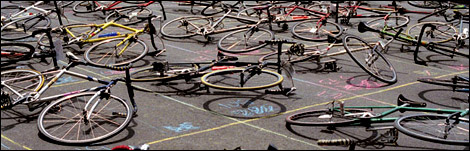
Art Show. BFF's Joy Ride! Brendt Barbur is at it again. His infectious movement spawned for his love of bikes is taking over a town near you. Tomorrow in Los Angeles, Brendt and his fam welcome all that celebrate two-wheeled transportation as the Sixth Annual Bicycle Film Festival (BFF) rolls into town. Launching the four-day festival, BFF invites you to take a joy ride at the Don O’Melveny Gallery as it hosts the kick off event for the festival entitled JOY RIDE: An Art Show Inspired by Bicycles.
JOY RIDE, curated by Elizabeth Ai and Brendt Barbur, is being held at the Don O’Melveny Gallery (5472 Wilshire Blvd.) and brings together artists from all over the world in celebration of largest bicycle related cultural event in the country. Participating artists include Swoon, Michel Gondry, David Choe, Shepard Fairey, and Peter Sutherland. Check out the flyer at the link below for more info. Also stay tuned for Dork's interview with Brendt Barbur for Issue #5.
Posted by: taj
Daily Update . June 19, 2006 | Gaming. From GTA to Ping Pong

Gaming. From GTA to Ping Pong: Earlier last month some of the Dork crew got to check out the Ping Pong release from Rockstar Games. It's awesome! It was intuitive, fun and had strong replay value. It's not one of those games you pick up and get tired of easily. The New York Times recently wrote a nice review of it in their tech section.
As reported by the NY Times, "WHEN I first read about Rockstar Games Presents Table Tennis, I thought it must be some kind of prank. How could Rockstar, the developer of such blood-drenched titles as Manhunt and Grand Theft Auto: Vice City, be making a table tennis game? It was as if Quentin Tarantino had announced plans to remake "Pride and Prejudice." Table Tennis is not a prank. Nor is it some sexed-up sports game like Outlaw Tennis; there are no illegal matches in disreputable warehouses or exploding Ping-Pong balls. It's a table tennis game, and quite a good one at that."
Read more about Rockstar's Ping Pong endeavor
Posted by: taj
Daily Update . June 17, 2006 | Habitat. WTHN Philadelphia
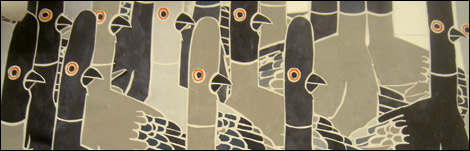
Habitat. WTHN Philadelphia: Philadelphia is one of the greatest cities on the planet. I know I'm biased, but it really is a hidden treasure. Thanks to places like Space 1026 and the ever-present art scene, the city of brotherly love is getting noticed. Get ready to add another reason to visit the Illadelph! Today a new boutique called WTHN opened up in Old City. Dork's resident writer and all around fashion guru, Catzie, caught up with the owner to talk shop.
Words by Catzie: Mason Warner is on a mission to help Philly, creatively. You've probably seen his work. He’s worked with the creative director of Urban Outfitters -- where he gained experience in design and construction. Over time his interests in clothing, sneakers and toys increased, which led him to Ubiq to become their Creative Director. Unhappy with the ways things were going, he decided it was time to make his own moves. So, he opened his own store, aptly called WTHN.
Posted by: taj
Daily Update . June 16, 2006 | People. Ricky Powell
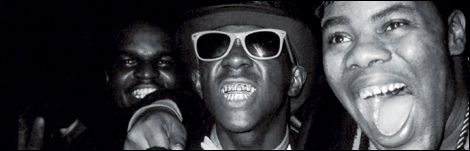
People. Ricky Powell: Do you remember a time before the digital camera? I don't either. Apparently, people used to put this thing called film inside of cameras instead of memory sticks. Boggle!
Well, Ricky Powell remembers. He made a name for himself crashing parties in New York, becoming a club scene fixture. Armed with just an instamatic camera, Powell documented the emerging world of hip hop. Public Access: Ricky Powell Photographs 1985–2005, showcases the people that have inspired him over the years. Some are famous, some aren't - they're all beautiful.
Preview photos from Public Access: Ricky Powell Photographs
Posted by: james

Film. The 11th Hour: Rappers are no strangers to hyperbole. You can't get through a typical album without hearing "this is history in the making!" or some other meaningless grandiose catchphrase like that. Whatever. I don't know if they do that for us or for themselves, but it isn't convincing.
Del is different. He doesn't seem to care about anything but the music. Del hasn't released an album in six years. He's anxious about his new project. He fears that people will discover that he's a one-trick-pony and lose interest. His anxiety has fueled an interest in musical theory. Del explains, "you've got to understand the way chords move because that's what's moving people in music. I knew what melody was, but I couldn't explain it. Now people may not like what I do, and that's cool, but they can't say I don't know what I'm doing." The 11th Hour is a refreshing hip hop documentary about a humble dude and his tunes. It shouldn't be missed.
Posted by: james
Daily Update . June 15, 2006 | Artist. Zero 7

Artist. Zero 7: I really love that scene from Garden State with Largeman at his friend's houseparty. Remember, everybody's raging out of control; drugs and sex are everywhere. Largeman just sits on the sofa, sedated, taking in the debauchery with a blank expressionless face. I don't think the scene would've had the same resonance without Zero 7's In The Waiting Line.
Henry and Sam know how to create music that's lush and evocative. For their third album, The Garden, they went back to basics. Henry built a studio on the English countryside and the team began recording. "I loved it" explains Sam. "It sounds like a hippie set up, and it was really. There'd always be a few people showing up having BBQs..."
Posted by: james

Artist. Jay Dee's Shining: We miss Jay Dee. However, it looks like he's left behind an enormous amount of work to influence generations upon generations to come. Recently when Dork was in Tokyo we found his work being celebrated on a whole different level. For example, we visited a Tower Records where they had his music displayed on all the walls, I *heart* dilla shirts were laid out everywhere and his latest release Donuts was on the lips of every audiophile there. It was great to witness. That alone made the trip worthwhile.
As BBE music states, on August 22nd Jay Dee's The Shining will serve as a testament to the fact that legends never die. Eddie Bezalel briefly discussed the album release saying, "releasing The Shining would only be possible if we could ensure that it be completed exactly how Dilla envisioned it. The only logical choice for his mother and us was Dilla's longtime friend and collaborator Karriem Riggins." Serving as Executive Producer, Karriem will oversee the completion of an already classic album that features Busta Rhymes, Common, Pharoahe Monch, Madlib, Medaphor aka MED, and Guilty Simpson. The theme of the album for Dilla can best be described by Karriem; "This album is inspired by and represents love. All the artists that contributed to this project Dilla considered family and when the world hears it, they will see that the love bleeds thru the music."
Listen to a tribute to Dilla by J. Rawls
Posted by: taj
Daily Update . June 14, 2006 | Artist. Aaron Wade
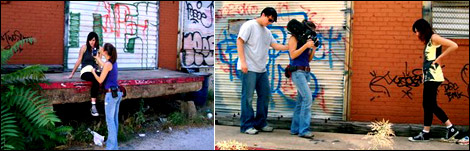
Artist. Aaron Wade: A few months back we gave you the good word about Aaron Wade, "[He] is a music video / commercial director based in Dallas, Texas. His latest project, a documentary film about the sneakerhead lifestyle, isn't your average. He's presenting a different perspective on street culture and sneakers. Aaron's not approaching it from the aspect of showing ridiculous collections, instead he's highlighting the pursuit - from saving hundreds of dollars for a pair of kicks to spending endless hours hunting!"
If you haven't caught on, he's got tons of talent and is writing about his adventures day by day. His blog is a daily read for the folks at the dork offices. You should check him out too. He's got some new projects lined up that are sure to please.
Read more about Aaron and his filming adventures
Posted by: taj

Literature. Oxherding Tale: Searching for self knowledge is extremely difficult. Distractions are everywhere. The Ten Oxherding Pictures depict a young ox herder searching for a lost ox. Based on ancient Buddhist texts, the pictures represent the journey of self discovery and transcendence. The ox herder is you and the ox is the self. The ox is lost, found, tamed and finally released within the panels of these 12th century paintings.
How do you embark on a journey of self discovery when an identity is forced upon you by slavery? Charles Johnson's novel, Oxherding Tale, is a traditional Buddhist myth that is written in the form of a slave narrative. And it's a comedy. A runaway slave passes for a white man in the antebellum South and encounters a series of adventures, sexual escapades, brutality and philosophical conundrums. He searches for an identity that transcends race, class and tradition while being chased throughout the South by a slave hunter.
Check out the Ten Oxherding Pictures
Posted by: james

Events. Tonight Heavy @ Canal! Rareform presents another electric event. Last time they brought you J*Davey and tonight they present music super-group, Heavy. It all takes place at the Canal Room in NYC. You don't want to miss this show.
The Dynamic duo of Nicky Guiland and Casey Benjamin -- aka Heavy -- are busy breathing new life into music with their vibrant synthesis of soul, pop, hip-hop and rock. Hailing from the rich hotbed of musical heritage that is Jamaica, Queens NY, the two have seized the baton from their wide range of influences ranging from Rotary Connection and Herbie Hancock to N*E*R*D and No Doubt. Be sure to catch them tonight as they set it on New York City.
For more information about tonight's event
Posted by: taj

People News. Designer Salaries: How much should I charge? That's the big question. Anyone doing freelance work knows the struggle of finding a fair rate. No matter how many times you visit the local book store or ask around, it becomes more apparent that pay rates are somewhat of a trade secret - especially in the design field.
The good folks over at Newstoday hipped us to AIGA's Survey of Design Salaries. It's a great resource for finding out yearly salaries, breaking down hourly rates and determining what is fair. It also has a host of other good stuff like a definitions guide to help you along. Definitely check it out.
Visit AIGA's Survey of Design Salaries [
Posted by: taj
Daily Update . June 13, 2006 | People News. Cars vs. SUVs

People News. Cars vs. SUVs: The collision of safety and design is always interesting. More often than not safety impedes the form of many great design ideas. It's another one of those constrictions all designers and engineers face. For example, the Pontiac Fiero was pretty cool back in the day - dentless, easy to clean, non-rusting body that was sleek and futuristic. Too bad the fiberglass was a fire hazard.
Today the NY Times has an interesting article about the adjustments being made in the design of SUVs to give cars a better chance of survival during crashes. As reported today, "A large number of sport utility vehicles and pickups that have been redesigned to reduce the threat they pose in collisions with smaller cars are now reaching the road. The changes to sport utilities and pickups are being made to prevent them from running over smaller vehicles in a crash. A recent study showed that the modifications, which automakers initially resisted but then agreed to adopt by late 2009, sharply reduced the number of deaths of people in cars struck by these vehicles."
Read more in the NY Times about Cars vs. SUVs
Posted by: taj
Daily Update . June 12, 2006 | Art & Design. The African Game

Art & Design. The African Game: With the World Cup in full swing, the Dork Offices have been in heaven. Non-stop soccer is the greatest - well, until you have the US v. Czech Republic game DVR'd for later viewing and someone blows it by telling you they loss. Nooooo!
But, we digress, in other soccer news there is a fantastic book out entitled, The African Game created by Knox Robinson and Nigerian filmmaker Andrew Dosunmu. This photo book does a fantastic job of capturing the passion of the sport. Cool Hunting has a nice interview piece with Knox about the process and product of The African Game.
Read Knox Robinson's interview about TAG on Cool Hunting
Posted by: taj
People News. Cellphones Parents Can't Hear! We had a hard time believing this one. Maybe it's our refusal to accept the fact that we're aging, but come on! A cellphone only kids can hear!? The New York Times has an interesting report on this new technology.
As reported in today's issue, "In that old battle of the wills between young people and their keepers, the young have found a new weapon that could change the balance of power on the cellphone front: a ring tone that many adults cannot hear. In settings where cellphone use is forbidden — in class, for example — it is perfect for signaling the arrival of a text message without being detected by an elder of the species."